Every completed workout in PR Project contributes to three numbers on your Training Balance card: CTL, ATL, and TSB. Together they describe your current fitness, recent fatigue, and whether you are in a productive training window or need more recovery.
This guide explains what each metric means, how the platform calculates them, and how athletes and coaches can use them when planning and reviewing training.
The big picture
| Metric | Full name | What it reflects | How fast it moves |
|---|---|---|---|
| CTL | Chronic Training Load | Long-term fitness built from consistent training | Slowly — weeks to months |
| ATL | Acute Training Load | Recent training stress and fatigue | Quickly — days to a week |
| TSB | Training Stress Balance | Balance between fitness and fatigue | Follows ATL day to day |
Think of CTL as your aerobic engine, ATL as how hard you have been working lately, and TSB as whether you are carrying fatigue or sitting fresh relative to that engine.
Where the numbers come from
Each workout generates a training load score based on duration and intensity relative to your thresholds (pace, power, or heart rate depending on sport). That daily load feeds two rolling averages:
- CTL uses a 42-day exponential average — roughly your fitness level over the past six weeks.
- ATL uses a 7-day exponential average — how much stress you have accumulated this week.
TSB is simply CTL minus ATL. When ATL is higher than CTL, TSB goes negative and you are carrying fatigue. When CTL is higher than ATL, TSB is positive and you are relatively fresh.
Rest days still matter: with no new load, both CTL and ATL decay over time, which is why a recovery week pulls ATL down faster than CTL and TSB rises.
CTL — Chronic Training Load (fitness)
CTL answers: How fit am I right now from consistent training?
- Higher CTL generally means a larger training base and greater capacity to absorb work.
- Lower CTL means you are early in a build, returning from time off, or in a deliberate down period.
- CTL changes gradually. A single hard session barely moves it; sustained weeks of appropriate volume do.
What coaches watch for
- Steady CTL growth during base and build phases — typically on the order of a few points per week for most athletes, not sudden spikes.
- CTL that stalls or drops during a block that should be building — often a sign of missed sessions, illness, or under-loading.
- CTL context when setting session targets: in PR Project, prescribed workout stress scales with current fitness so load stays appropriate as CTL rises.
What athletes should know
Your CTL is not a grade. A runner at CTL 45 and a triathlete at CTL 80 are not comparable in absolute terms. What matters is your trend over time and whether training load matches what you and your coach are trying to accomplish.
ATL — Acute Training Load (fatigue)
ATL answers: How much stress have I stacked up recently?
- Higher ATL means more hard or frequent training in the last several days.
- Lower ATL means lighter recent training — rest, recovery, or taper.
- ATL responds quickly. A big weekend can move it noticeably by Monday.
ATL does not tell you whether that stress was good or bad — only that it happened. Pair it with TSB and how you feel to decide if today is a push day or a back-off day.
TSB — Training Stress Balance (form)
TSB answers: Am I productively tired, overreached, or well rested?
Because TSB = CTL − ATL:
- Negative TSB — ATL exceeds CTL. You are carrying fatigue. Normal during hard training blocks; problematic if it stays deep for too long without recovery.
- Near your goal range — a productive balance for steady training.
- Very positive TSB — ATL has dropped well below CTL. You are fresh — common after a recovery week or taper before a race.
The Training Balance card in PR Project
On the mobile app Account Home dashboard, the Training Balance card visualizes TSB on an arc from −40 (carrying fatigue) to +40 (fully fresh), with four zones:
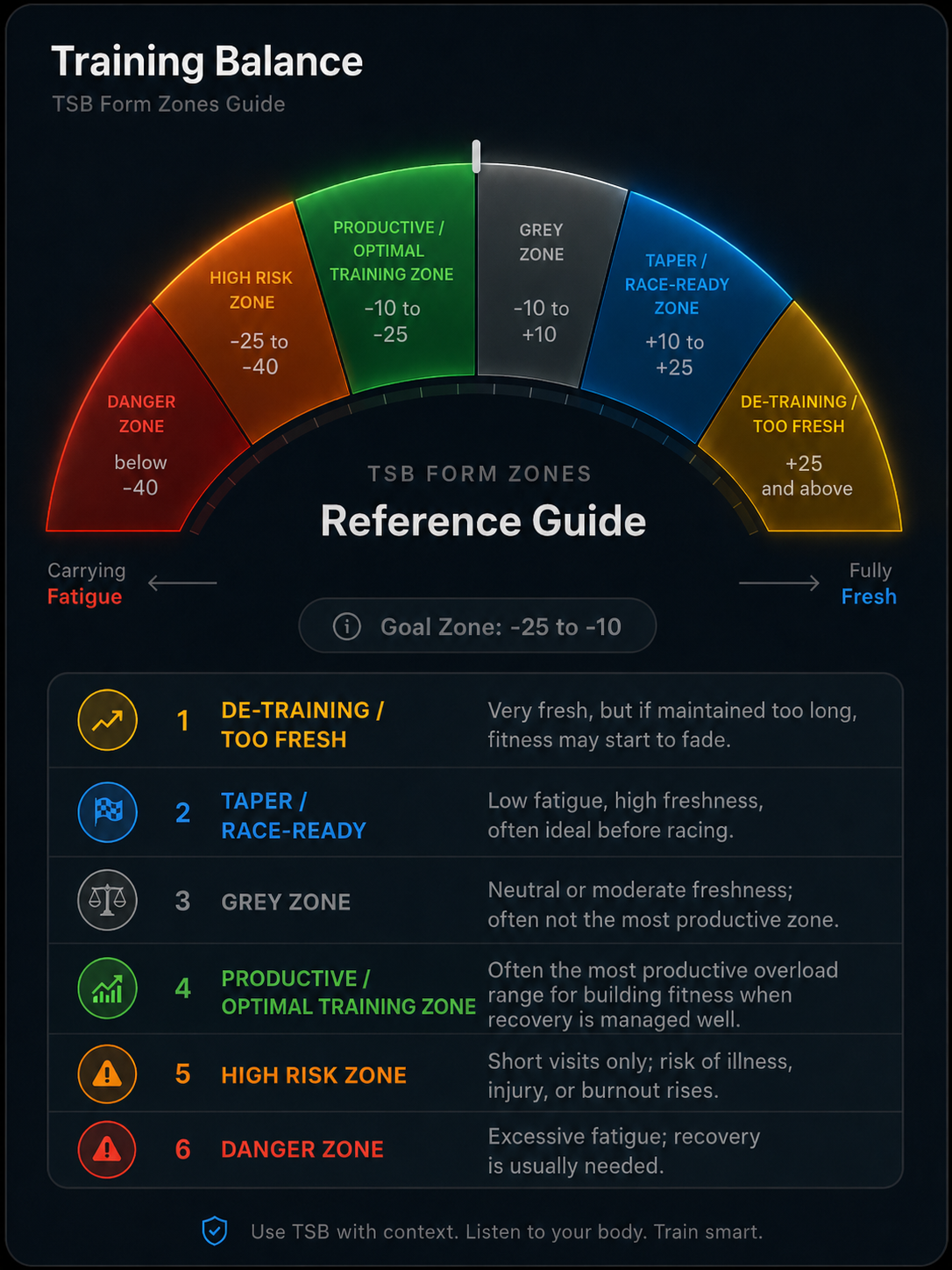
| Zone | What it means | Typical guidance |
|---|---|---|
| Overreaching | TSB is well below your target | Back off — prioritize recovery before adding more load |
| Productive | TSB is near your coach-set goal | Good window to keep building |
| Maintaining | Moderately fresh, above productive | Hold steady to maintain form |
| Fresh | Well rested | Good day for a hard session or race-pace work |
The green goal band on the arc marks the Productive zone. Your coach sets a TSB target during onboarding (the default is −20). Productive training is defined as within ±5 of that target — the same tolerance PR Project uses when monitoring training balance.
That means “good” TSB is not one universal number. A coach building an athlete through a hard block may target around −20; during taper the target shifts fresher. Always read your zone relative to your goal, not a generic chart.
The card also shows CTL and ATL as ring gauges so you can see fitness and fatigue side by side with the TSB arc.
Worked examples
CTL 62 · ATL 45 · TSB +17 (goal −20, zone: Fresh / Maintaining)
You have a solid fitness base and have trained hard recently, but ATL has come down enough that TSB is positive. Reasonable day for quality work if the plan calls for it — not necessarily a maximal test session unless you are tapering.
CTL 55 · ATL 52 · TSB +3 (goal −20, zone: Overreaching)
Fitness is building, but recent load is very high relative to CTL. Fatigue is elevated even though TSB is barely positive. Favor aerobic endurance or easy work unless your coach prescribes otherwise.
CTL 70 · ATL 78 · TSB −8 (goal −20, zone: Productive)
ATL is above CTL — you are in a deliberate loading phase. Productive for training if duration and intensity are managed; watch sleep, nutrition, and subjective feel so fatigue does not slide into overreaching.
How athletes can use these metrics
- Before a key session — Check TSB against your goal. Deep in Overreaching? Talk to your coach before forcing a hard day.
- During the week — Notice whether ATL is climbing faster than planned. That is early signal you may need an easy day.
- Over months — Is CTL trending in the direction of your goal event? Flat CTL during a build block often means consistency or volume needs attention.
- With your coach — Bring numbers to check-ins: “My CTL has been flat for three weeks” or “TSB has been overreaching since the weekend block.”
How coaches can use these metrics
- Set phase-appropriate TSB targets — Match the goal to base, build, peak, or taper so the Productive band reflects what you want that athlete to feel.
- Scale prescription to CTL — Session stress in PR Project anchors to current fitness; rising CTL automatically raises appropriate load targets.
- Guard against overload — Sustained Overreaching or ATL persistently above CTL without planned recovery is a flag to adjust volume or intensity.
- Explain decisions — When you pull an interval session or add recovery, pointing to ATL/TSB gives athletes a concrete reason beyond “trust me.”
Common questions
Do I need to memorize formulas?
No. Know that CTL = long-term load, ATL = short-term load, TSB = the difference. The app does the math.
Why does TSB not match what I feel?
Metrics lag reality and do not capture sleep, life stress, or illness. Use TSB as one input alongside RPE, HRV if you track it, and conversation with your coach.
Is higher CTL always better?
No. CTL should fit the event and phase. Uncontrolled CTL growth with no recovery leads to injury and burnout.
Why is my TSB target negative?
Productive endurance training often runs with ATL slightly above CTL — a small negative TSB means you are productively absorbing work, not fully rested. Your coach sets the target for your current block.
Summary
- CTL tracks fitness from weeks of consistent training load.
- ATL tracks recent fatigue from the past week.
- TSB compares the two so you know if you are loaded, balanced, or fresh.
- The Training Balance card zones interpret TSB against your coach’s target, not a one-size-fits-all scale.
Used together, these metrics help athletes train with intention and help coaches scale load, time recovery, and communicate why today’s session looks the way it does.