Most endurance coaches do not want a black-box training app making random decisions under their brand. That is not the future PR Project is building toward — the vision is to help coaches scale their methodology, not replace it.
The low-touch version of the platform is designed to give athletes a structured training experience under the coach's brand, while giving the coach governance over the rules, training philosophy, workout library, progression logic, and safety boundaries that shape how training is prescribed.
In plain English: PR Project is not “AI coaching instead of your coaching.” It is your coaching system, packaged into software, supported by automation, and protected by configurable guardrails.
Product direction, not a feature checklist. This article describes where PR Project is headed—not every capability here is fully live today. For what the Push Workouts pipeline does right now, see the Auto-Push article.

§ 01 — The core ideaAutomation should scale the coach, not erase the coach.
The biggest fear coaches usually have with automated training is simple:
If the app writes the plan, is it still my coaching?
That is the right question.
Our answer is that PR Project only works when the coach's system remains the foundation. The platform is built around coach-defined inputs and coach-approved training structures. The algorithm uses those inputs to make plan decisions at scale, but it does not invent a brand-new coaching philosophy every time an athlete joins.
A coach can configure the platform around things like:
- Preferred training style
- Workout templates
- Weekly structure
- Intensity distribution
- Volume progression
- Recovery rules
- Race-specific preparation
- Athlete experience level
- Injury-risk boundaries
- Communication style
- How aggressive or conservative the plan should be
The algorithm then applies those rules consistently across athletes while still adapting to individual context.
Philosophy · Templates · Weekly structure · Training emphasis · Guardrails · Brand voice
Applies your rules consistently · Individualizes each athlete
§ 02 — Product directionWhat the planning system is designed to do.
The PR Project workout push pipeline is being built to turn coach-approved structures into concrete sessions on the calendar.
Training emphasis and CTL: For pushed workouts, target session stress is anchored by Chronic Training Load (CTL) and sport- and workout-goal training emphasis (defaults apply unless the coach has configured training emphasis in the database). Those combine into a target stress before templates are matched. Near prioritized races, taper logic further adjusts applicable training emphasis so prescriptions trend lighter approaching race day.
At a high level, the vision for planning draws on three categories of information:
- Athlete profile — Fitness context carried into planning (including CTL by sport), goals, availability constraints, and calendar context such as races.
- Training state — Load metrics derived from completed activity (CTL, and—when AI-assisted training-emphasis tuning runs— additional signals such as TSB and subjective notes used inside policy guardrails).
- Coach configuration — Weekly structures (sport, day, workout goals), the template library, configured athlete phases, race priorities on the calendar, and coach-defined training emphasis where set.
In practice, each push window is intended to resolve questions such as:
- Which slots in the athlete's weekly pattern need workouts in this date range?
- What target training stress fits each slot given CTL and training emphasis (and taper when races apply)?
- Which approved templates best match sport, goals, and that target?
- How do phase and upcoming events affect taper scaling for this push?
The goal is not to produce the flashiest-looking plan. The goal is to prescribe the next executable session that fits the coach's structure and measured fitness—not arbitrary cookie-cutter volumes.
Inputs
- Athlete profile — goals, history, availability
- Training state — load, fatigue, completion
- Coach configuration — templates, training emphasis
Decision engineCORE
Combines CTL and training emphasis into target stress, picks templates, and respects weekly structure inside your guardrails.
Training calendar
The next productive week—not a generic template—based on context and your methodology.
Athlete profile
- · Fitness level
- · Goals
- · Availability
- · Constraints
Training state
- · Recent load
- · Completion
- · Fatigue signals
- · Trends
Coach configuration
- · Templates
- · Weekly structure
- · Training emphasis
- · Governance
Race / goal context
- · A-races
- · Blocks
- · Taper timing
- · Specificity
Safety guardrails
- · Caps
- · Recovery cadence
- · Beginner rules
- · Overrides
§ 03 — The coach's lensThe coach controls the training philosophy.
Every coach has a different lens.
Some coaches prefer high-volume aerobic development. Some prefer polarized training. Some rely heavily on threshold development. Some use race-specific blocks. Some are more aggressive. Some are more conservative. Some want strength training integrated year-round. Others want it minimized during race-specific phases.
PR Project is being built to support that variation.
The coach can shape the low-touch experience by configuring the principles the system should follow. For example, a coach may decide:
- Beginners should never receive more than two intensity days per week.
- Marathon athletes should prioritize long-run progression and threshold durability.
- Triathletes should preserve bike frequency even during run-focused blocks.
- Recovery weeks should occur every third or fourth week.
- Athletes returning from inconsistency should receive a conservative ramp.
- Race-specific workouts should only appear after a base period.
- Certain workout types should be excluded for certain athlete levels.
This is where PR Project becomes more than a generic training-plan generator.
The software does not just ask, “What does a runner need?”
It asks, “Given this athlete, this goal, this current training state, and this coach's methodology, what is the right next prescription?”
§ 04 — Intellectual propertyThe coach controls the workout library.
For many coaches, the real intellectual property is not just the weekly structure. It is the workout library.
The way a coach writes sessions matters:
- Warmup style
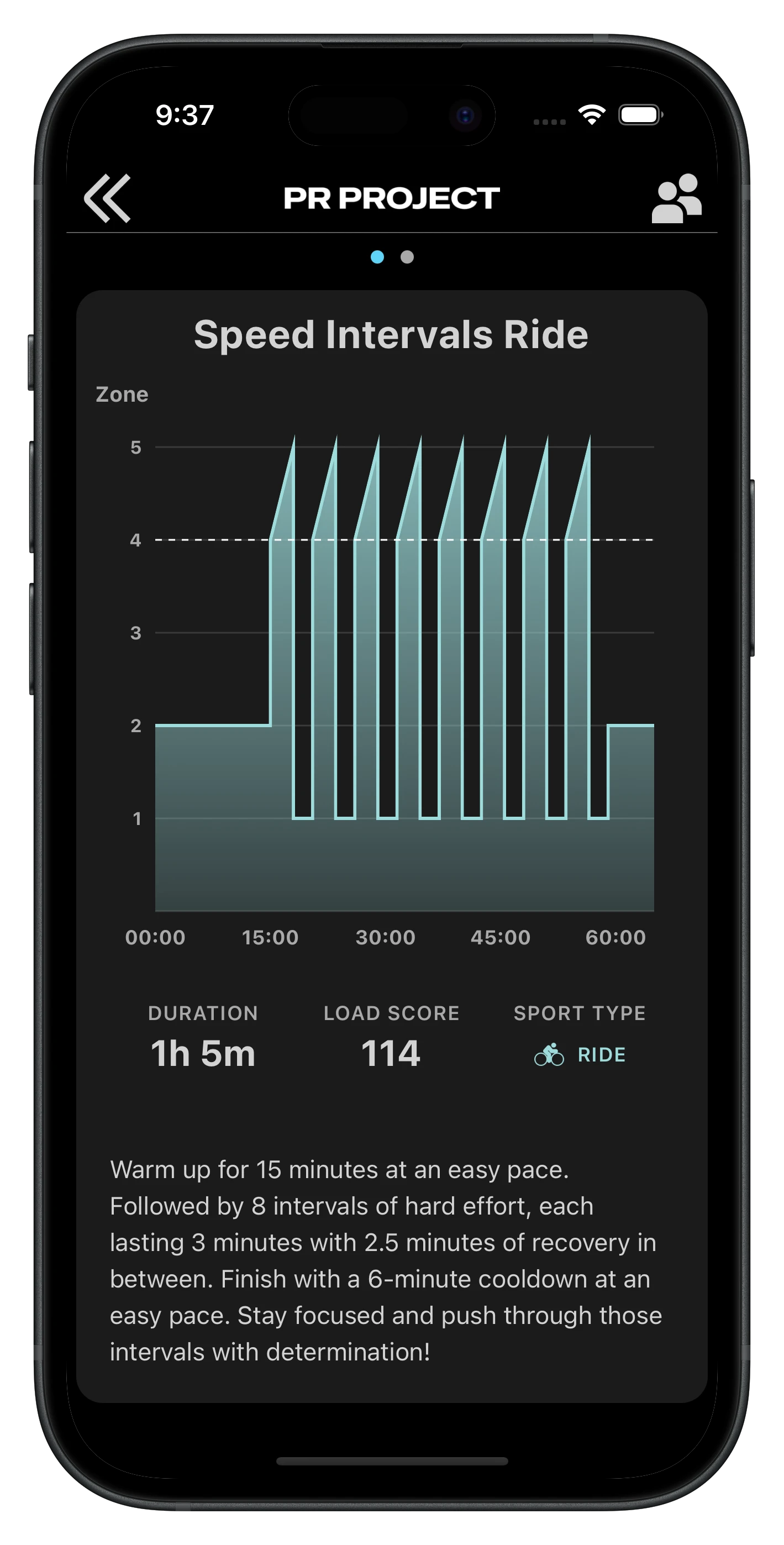
- Interval structure
- Intensity language
- Workout purpose
- Progression from week to week
- How workouts are explained to the athlete
- Sport-specific details
- Race-specific sessions
- Beginner-friendly vs advanced versions
PR Project is being built to let coaches build or approve the workout templates that the algorithm pulls from. That means the low-touch platform can still feel like the coach's product.
Instead of inventing intervals from scratch with no oversight, the push pipeline draws from a coach-approved library: weekly patterns decide what kinds of sessions belong on which days, then templates are chosen and scaled toward each slot's target stress (CTL × training emphasis, with taper modifiers when applicable).
This protects the coach's brand voice and training style.
It also creates consistency across the athlete experience.
Sessions chosen from your templates—not invented from scratch—then adapted to the athlete's week.
§ 05 — Safety boundariesThe coach controls the guardrails.
Governance matters because training prescription has consequences.
A bad algorithm does not just create a bad user experience. It can overtrain athletes, progress them too aggressively, prescribe intensity at the wrong time, or fail to respect injury risk.
PR Project is being built around guardrails that help prevent the low-touch product from becoming reckless.
Examples of guardrails may include:
- Maximum weekly load increase
- Maximum run mileage increase
- Maximum number of intensity sessions per week
- Minimum recovery between hard sessions
- Recovery week frequency
- Long-run percentage limits
- Beginner-specific safety rules
- Return-to-training ramp rules
- Injury-risk flags
- Missed-workout adjustment logic
- Taper rules before races
- Coach override rules
These rules allow coaches to decide how much freedom the algorithm has.
A coach serving experienced competitive athletes may allow more aggressive progression. A coach serving beginners, longevity clients, or injury-prone athletes may choose a much more conservative configuration.
The important point is this:
The algorithm should not be allowed to make unlimited decisions.
It should operate inside a controlled coaching framework.
§ 06 — Real life, not perfect weeksThe algorithm adapts, but it does not ignore reality.
Training plans fail when they act like the athlete lives in a perfect world.
Real athletes miss sessions. They get sick. They travel. They have bad sleep. They overperform. They underperform. They start a plan with inconsistent history. They have races coming up. They have weeks where life gets messy.
Planning today is grounded in measurable fitness (CTL) and coach-defined weekly patterns—not a generic PDF that ignores how fit the athlete actually is. Optional AI-assisted adjustments can refine training emphasis within validation guardrails when that mode is enabled for a deployment.
Inputs the workout push system is designed around include:
- Completed activity that drives CTL (and therefore session targets)
- Coach weekly structures—what each day is supposed to emphasize
- Races and priorities on the calendar (including taper scaling)
- Athlete availability for scheduling windows
- When AI-assisted emphasis tuning runs: questionnaire responses, coach notes, and load metrics supplied to the emphasis policy (still constrained by clamps and templates—not free-form workout authoring)
What that is intended to mean in product behavior:
- Session targets move with CTL and training emphasis instead of using the same nominal workload for everyone.
- Prioritized upcoming races trigger taper-style reductions to training emphasis through the existing taper pipeline.
- Templates—not prose hallucinations—remain the unit of delivery; the system maps structure + stress targets to library workouts.
- Fine-grained "re-write the whole week because Tuesday fell apart" logic may expand over time; the current critical path is CTL, training emphasis, structure, and template-driven scheduling as described above.
The platform's job is to turn coach methodology into repeatable scheduling mechanics—not to pretend every week is perfect, but to tie prescriptions to fitness and configuration athletes already have on the platform.
Static plan
- Missed sessions pile into guilt stacks
- Load progresses on the calendar, not on reality
- Fatigue and inconsistency get ignored
Adaptive · PR Project
- Targets scale with CTL × training emphasis, not one-size-fits-all volumes
- Race-aware taper reduces emphasis near prioritized events
- Coach weekly structures + templates—not ad-hoc AI workouts

§ 07 — Judgment in the loopCoach override is a feature, not a failure.
Automation is useful, but coach judgment still matters.
PR Project is built with the assumption that the coach may want to review, adjust, or override parts of the system.
That matters especially during:
- Race week
- Injury return
- Plateau phases
- High-performance blocks
- Major goal races
- Unusual athlete schedules
- Complex triathlon builds
- Athletes with unique constraints
The low-touch model does not mean the coach has no influence. It means the coach does not need to manually build every day of training for every athlete.
When needed, the coach can still step in and adjust the system's output.
That creates a better business model for the coach and a better safety model for the athlete.
The goal is not full automation at all costs.
The goal is the right blend of automation, coach governance, and human judgment.
Fully automated
Routine weeks flow under your guardrails.
Coach review
Spot-check outputs before key phases or races.
Coach override
Step in anytime—judgment stays in the loop.
§ 08 — Quality, not corner-cuttingLow-touch does not mean low-quality.
A common mistake in coaching businesses is treating low-touch offers like cheap, generic products.
That is not the vision for PR Project.
Low-touch should mean lower manual labor for the coach, not lower-quality training logic for the athlete.
The coach still brings the methodology. PR Project provides the systemization layer.
That allows a coach to serve athletes who may not be ready for full 1:1 coaching but still want something more thoughtful than a generic PDF plan.
This creates a better ladder inside the coaching business:
- Free content builds trust.
- Low-touch training gives athletes a structured way to start.
- Higher-touch coaching becomes available for athletes who need more accountability, personalization, or direct coach access.
The low-touch product can become both a revenue stream and a feeder system for premium coaching.
§ 09 — For athletesWhat this means for athletes.
For athletes, the benefit is simple:
They get training that is more personalized than a static plan, more affordable than full 1:1 coaching, and still built under the philosophy of a real coach.
That means the athlete is not just buying access to software.
They are buying access to a coach's system.
The plan can adapt to their goal, availability, fitness level, progression, and training history while staying inside the coach's approved methodology.
This is especially valuable for athletes who want direction but are not ready for the cost or commitment of full-service coaching.
| Option | Personalization | Coach philosophy | Adaptability | Cost |
|---|---|---|---|---|
| Generic PDF plan | Low | Low | Low | Low |
| PR Project low-touch | Medium–High | High | High | Medium |
| 1:1 coaching | Highest | Highest | Highest | High |

§ 10 — For coachesWhat this means for coaches.
For coaches, the benefit is leverage.
Most coaches eventually hit the same ceiling: they can only manually coach so many athletes before quality drops or life gets consumed.
PR Project helps coaches package their training system into a scalable product.
That gives coaches a way to:
- Serve more athletes without manually writing every workout
- Create a lower-priced offer without destroying their calendar
- Protect their methodology with configurable rules
- Turn their workout library into a scalable asset
- Build a stronger funnel into premium coaching
- Keep athletes inside their brand instead of sending them to a generic app
- Offer a more professional product to their audience
The coach remains the brand.
PR Project becomes the infrastructure underneath it.
Voice, methodology, trust—still yours.
Planning, automation, integrations, guardrails.

§ 11 — PhilosophyThe philosophy behind the system.
Our philosophy is simple:
Good coaching is not random.
It is a repeatable decision-making system.
A great coach already has rules in their head. They know when to progress, when to hold back, when to add intensity, when to protect recovery, when to prioritize specificity, and when an athlete is not ready for more.
PR Project helps turn that coaching judgment into a scalable operating system.
The best version of this is not “AI replaces the coach.”
The best version is:
- The coach defines the system.
- PR Project applies the system.
- The athlete receives the plan.
- The coach keeps governance.
- The athlete can move up the coaching ladder when they need more support.
That is how low-touch coaching becomes scalable without becoming generic.
§ 12 — Vision summaryBuilt around coach governance.
The coach controls the methodology, workout library, training emphasis, guardrails, and override path. The platform is designed to use those inputs to generate individualized training at scale—a low-touch product that still feels like the coach's product.